Introduction

The bokken or bokuto is an essential tool in the Bujinkan martial art, which originated in Japan and combines elements of various disciplines such as Ninjutsu, Taijutsu and Kenjutsu. The bokken is a replica of a traditional Japanese sword, but is made of wood instead of steel, allowing for safer and more controlled training. The word “bokken” is derived from “boku~moku” meaning “wood” and “ken” meaning “sword”.

Bujinkan practice involves the use of a variety of weapons, including bokken. Bokken training is essential to develop the technique, strength, speed and accuracy needed to wield a katana safely and effectively. In addition, bokken training also helps to improve coordination, concentration and reaction skills.

Parts of the Bokken

The bokken is made from a single piece of wood, to which other elements are then incorporated. The parts of the bokken are described here: 

  • The “tsuka” (柄) is the hilt of the bokken. It is the part that is held in the hand and is located at the bottom of the Bokken, it is delimited by an indentation in the carving, from which the carving changes. It is designed to provide a secure and comfortable grip for the user. It is often wrapped with a cord or cloth to improve grip, and may have a decorative covering such as leather or cloth. 
  • The blade or shinogi (鎬 or 鐃) is the part used for striking and cutting and is located at the top of the bokken, it is designed to provide great strength and durability.
  • The tsuba (鍔 or 鐔) is a piece that is placed on the bokken between the blade and the tsuka. Its main function is to delimit this border area between tsuka and shinogi in order to understand the size ratios that will be very similar on the katana, where the tsuba has a more obvious role: to protect the user’s hands from injuries caused by accidentally hitting the blade. In addition, it is also used as a decorative and symbolic element in some cases. Some bokken come with a tsuba included, while others are sold without it and can be purchased separately. On the katana the tsuba is made of metal, while on the bokken it is almost always made of hard plastic.
  • The tsubadome (鍔止め or 鐔止め) is the mechanism for attaching the tsuba to the bokken. It is made of semi-elastic hard rubber, which allows it to be removed for washing and maintenance of the weapon. 
  • The “saya” (鞘) is the sheath of the bokken. It is the sheath used to protect the blade and is usually held in Bujinkan with our “Obi” (帯) belt.

Of all these parts, the only essential parts are the Tsuka and the Shinogi. 

Bokken in Bujinkan

In Bujinkan, the bokken is used to practice cutting and striking techniques, as well as to improve fencing technique. It is a key tool for developing coordination, accuracy and confidence in handling weapons. It is also used to practice self-defence techniques and to improve reaction and movement skills. In that sense, there is a group of advanced sword evasion techniques (Muto Dori Kata), which Hatsumi Sensei has emphasised for years, which are usually practised in front of bokken. 

In Bujinkan training, students learn how to handle the bokken safely and effectively. Basic techniques such as horizontal and vertical cuts are taught, as well as advanced techniques such as blocks and counter-attacks and reverse guards. In addition, kata and bokken combat forms are practised, which are a form of training to improve technique and physical condition.

In that sense, it is worth talking about the suburi bokken, suburi bokuto or suburi to, which is a sturdy, wide and heavy variant of the traditional bokuto. It is used to practice basic strikes and cuts, such as suburi shomen, suburi yokomen and suburi sayu men. These strikes are executed with repetitive movements, increasing speed and accuracy over time, as well as stamina and strength. It is said that the legendary Miyamoto Musashi wore one in one of his most famous duels.

In addition to improving kenjutsu technique, suburi also helps develop physical fitness and is a very attractive element of Tanren Ho. By performing repetitive movements with the bokken, it works on arm, shoulder and back strength, as well as cardiovascular endurance.

Types of Bokken available online

In this first entry on bokken we will not go into great detail about establishing a guide to buying them. We will mention three popular websites where you can browse and choose yours. In a future post, we will make a comparison between the three sites. These sites are Amazon, Decathlon and Tozando. We have chosen these three because of their characteristics as retailers:

  1. Amazon is a global retailer of a generalist nature. This implies that it is potentially feasible to find any product, but that finding the right one can be difficult.
  2. Decathlon is a generalist company within a specific niche: physical activity and sport. Budo is a specific sub-segment and many beginners wonder if they are doing the right thing by investing their money in buying equipment in shops like Decathlon.
  3. Tozando is possibly the best online shop for Martial Arts related products, especially weapons, and we will treat their products with all the justice they deserve. In fact, Tozando’s products are so good, that we will probably make several posts dedicated to some of the components of their products.

For all shops, let’s assume that you are purchasing a bokken for the first time. There are more advanced, aesthetically elegant or more durable variations on some of these products, but we want to keep it simple for the first experience. We hope you find it useful.  

Amazon:

On Amazon it is easy to find products of all kinds, and Martial Arts is no exception. It is true that the variety is overwhelming and that there are a multitude of international sub-shops, which is why we have restricted the content of this post to the most essential examples.

Image 1: bokken white wood (Oak) with tsuba. Image 2: Saya. Image 3: bokken redwood (beech) 

Tozando:

Nyumon Starter Set (white oak): 110 USD. Click the image to access the shop.

This set is designed to give you everything you need to start kenjutsu/iaido with a bokuto and all the important accessories. The quality is excellent, both in terms of durability and aesthetics, considering that this is a basic line.

Bokuto Deluxe Tsuwaki (for Kendo): 127.52 USD. Click the image to access the shop.

In this case, it is a bokuto without saya or tsuba but of higher quality than the previous one, both in terms of the sturdiness of the wood and its finish. If you are looking for a product that is superb in quality and extreme in its simplicity, we recommend this one.

Decathlon

The cheapest offer can be found at Decathlon. On the other hand, as mentioned above, the main limitation is the lack of variety and the basic nature of the product. Even so, the quality is sufficient to start training with this product.

Bokuto outshock: 28,99€. Click the image to access the shop.

Conclusion

We have cautiously delved into the deep world of Bujinkan Wooden Weapons and the premiere has necessarily been with the wooden version of the Budo queen. The bokuto or bokken is a versatile and complex weapon, we should not limit ourselves to seeing it as the wooden version of the katana (which in itself would be a lot). If you want to start training with bokuto, you have some interesting product offers on our website. Good luck with your bokuto
Navigation

Introduction to Junan Taiso and Tanren-ho

Junan Taiso and Tanren ho are two physical conditioning methods that are fundamental to Bujinkan Ninjutsu training. Both focus on strengthening and toning the body to improve physical ability and endurance in the martial art. In this post, we will explore the benefits of these fitness methods, as well as some basic and advanced exercises to help you incorporate them into your training routine.

Before we begin, it is important to note that physical conditioning (a concept that encompasses both Junan Taiso and Tanren ho) is a vital part of Bujinkan training. Although the martial art focuses on combat and self-defence techniques, a strong, elastic and resilient body is essential to be able to execute these techniques effectively. In addition, physical conditioning can also help prevent injuries and improve overall health.

We all know the stories of the ninja, with their legendary agility. But they have also been described since ancient times as “invisible” or fighting like animals or demons. This is due to the ability to master the joints, on the one hand, and the immense technical effectiveness and effective force that can be generated for multiple strikes. And all this derives from a good practice of Junan taiso and Tanren ho.

In the Bujinkan world it is common to find messages and blog posts about the physical aspect being the least necessary. This is an unintentional but potentially dangerous mistake, as it leads many practitioners to disappointment and sometimes physical injury. The duty of a practitioner is to try to adapt his body as much as he can to the demands of his Art and not to bring the Art to the limitations, temporary or permanent, imposed by his body. 

Bujinkan Tenerife Junan Taiso
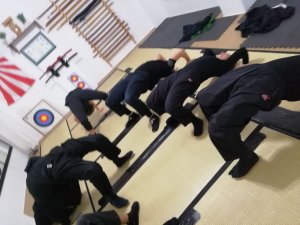
We practise Junan Taiso in our Dojo

Benefits of Junan Taiso for Bujinkan training

Junan Taiso is a traditional Japanese fitness technique that focuses on strengthening the body through gentle, controlled, elasticity-enhancing exercises. It is also known as Ryu tai undo Ho (dragon body exercises). If one imagines the anatomy and physiognomy of the dragons of the Far East (extremely strong and flexible), one understands the simile perfectly. Junan Taiso exercises are based on slow and fluid movements, such as breathing and stretching. These exercises are ideal for improving flexibility, endurance and coordination. In addition, they can also help to improve concentration and relaxation.

Basic Junan Taiso Excercises

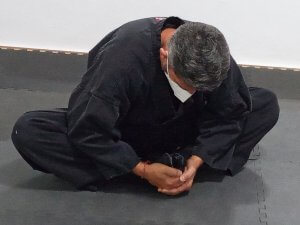
Some basic Junan Taiso exercises include the wheel exercise, which focuses on strengthening the back muscles, and the tree exercise, which focuses on strengthening the muscles of the legs and buttocks. These exercises are easy to learn and can be adapted to any level of physical ability, with personal limits dictating the threshold between discomfort and pain.

Práctica de Junan Taiso

Basic Tanren ho Excercises

Tanren ho is another fitness method that focuses on strengthening and toning the body. Unlike Junan Taiso, Tanren ho relies on more intense and dynamic exercises, such as weight lifting and cardiovascular exercises, as well as conditioning for receiving punches. These exercises are ideal for improving strength, endurance and speed. They are more dynamic exercises and depend on the elements at one’s disposal, such as makiwara, gym equipment, peg boards, one’s own Budo Taijutsu weapons, nature, etc. 

How to incorporate Junan Taiso and Tanren ho into your training routine

To incorporate Junan Taiso and Tanren ho into your training routine, it is advisable to start with basic exercises and gradually increase the intensity as your level of physical ability improves. It is important to listen to your body and not overestimate your own capabilities, as this can result in injury. In addition, it is advisable to practice both fitness methods in a balanced way, as each has its own benefits. In our regular classes, we emphasise Junan Taiso, as here physical abilities that are spontaneously degraded by normal Western life are enhanced. You should adapt the proportion of each workout to the needs of your body at any given time.

Tips for maximising fitness benefits

Other tips to maximise the benefits of fitness include:

  • Practice regularly: Fitness is an ongoing process and it is important to practice regularly to improve and maintain your level of physical ability. We have a related post on the importance of regularity.
  • Adequate rest: Rest is essential for recovery and progress in fitness. It is important to allow the body to recover properly between training sessions. There will also be an entry dedicated to rest in martial arts. 
  • Eating a balanced diet: A balanced diet is essential to provide the body with the nutrients necessary for fitness and recovery. A series of entries directly related to nutrition will be coming soon.

Adopt a Japanese mentality

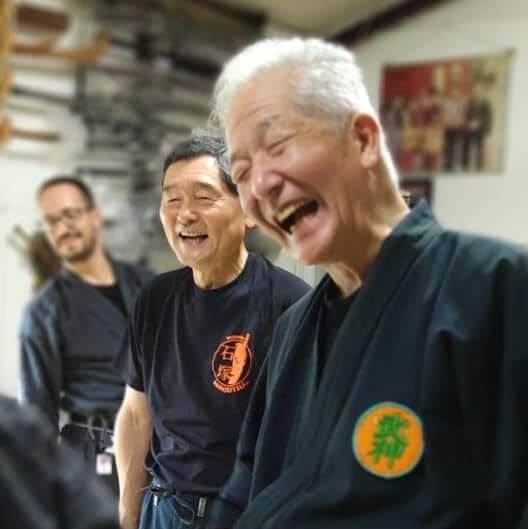
By this we mean that sometimes, due to the metaphorical nature of the Japanese language, we Westerners tend to take some of Hatsumi Sensei’s statements literally, and others metaphorically. In the video linked below, the Sôke is shown demonstrating some of the Junan Taiso movements, which he executed with precision and ease. As he explained, Hatsumi Sensei said that these movements had to be done well when we were 65 years old, and the Westerners laughed. The Westerners laughed. Can you guess how old Hatsumi Sensei was as he executed the moves perfectly in front of everyone? Judge for yourself:

Ryutai Undo Ho
Hatsumi Sensei executing Junan Taiso

Final conclusions and recommendationss.

In conclusion, Junan Taiso and Tanren ho are two fundamental physical conditioning methods for Bujinkan training. Both focus on strengthening and toning the body to improve physical ability and endurance in the martial art. Incorporating these methods into your training routine, along with a balanced diet and adequate rest, will help improve your physical ability and prevent injury. In the case of Junan Taiso there is a huge group of fundamental techniques that are impossible to do without a proper degree of flexibility.

Navigation

Lo quiero todo y lo quiero ya.

We live in unique times. Some 30 years ago, obtaining extensive information on a particular subject was a relatively arduous task. Today we can access a staggering amount of information instantaneously almost anywhere and we are becoming accustomed to that kind of life where immediacy and instant gratification are the norm, making it difficult to focus on long-term projects, and increasingly, the lack of consistency in modern life is becoming more and more common among us all.

These habits encourage concepts such as efficiency, which we interpret as “wanting results as quickly as possible”, but we must realise that there are areas where this concept is modified and the method of achieving results is different: In the case of Bujinkan and martial arts in general, we must adopt the mentality of “cultivating” this activity through perseverance.

Not being consistent when practising a martial art or sport can lead to not reaching our goals and not getting the desired results, which will probably have an impact on our motivation to continue practising it, which could also reduce our health and thus a domino effect of negative consequences.

This post is an extended response to some of the most frequently asked questions from our Ninjutsu community: you can read the rest here.

Constant practice
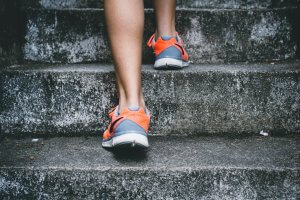
Constant practice is a never-ending ladder

Benefits of consistency.

Whenever a practitioner decides to train Ninjutsu, he or she is committing to a long-term learning process. This means that time, effort and sacrifice must be made in order to achieve the desired accomplishments. According to many martial arts masters, determination is the key to long-term success. This means staying motivated and dedicated to the practice of Ninjutsu despite difficulties. It is also important to be consistent in research, reading and practice in order to develop a deep understanding of the discipline.

Among the virtues of perseverance, we highlight:

  • It helps to improve aspects of our character such as our self-control, resilience, discipline and sense of responsibility. All of the above usually have an impact on our self-esteem and will help us feel more confident when we are alone or in an unfamiliar situation.
  • Problem solving: Perseverance helps us to develop a solution to the problems we face. This is achieved by adopting a disciplined approach and persistence in finding the right solution as some of the things we learn do not produce short-term change but help to develop different views of a problem and to learn from difficulties.
  • It allows us to access increasingly complex learning. Keep in mind that in Ninjutsu there are very precise movements that require special coordination, they come from techniques that masters with exceptional skills spent a lifetime developing, it is normal that they require time. If we try to do everything quickly we can get injured, bored and often end up crushed! Some training, such as particularly complex techniques, requires physical and mental recovery.
  • Like all physical activity, it provides benefits such as improving our endurance, strength, coordination, balance and flexibility. This helps to develop better posture and fitness and reduces the risk of injury, which has an impact on overall health and wellbeing.
  • It improves our personal relationships and our ability to work as a team: Day in and day out, we will find ourselves training with other colleagues, people who have strengths and weaknesses and if we watch carefully, we can learn at least one different thing from each of them. One can fall into the error that the difference in level can hinder one or the other, but the task of a Dôjo is to share: that we all learn from each other will make the newcomers advance faster and the experts reflect on how and “why” things are done. Or as an old proverb says: “If you want to go fast walk alone, if you want to go far walk together”. Besides, without our companions it is not the same!

The way

When talking about martial arts, we always hear references to the “way”.
The way is an important concept in the world of martial arts. It refers to the pursuit of a common goal through discipline, hard work and practice. It represents the progress and growth of the practitioner as they advance in their training. 

Martial arts practitioners continually seek to improve their technique and skills, and the path is a metaphor for this learning process. An interesting thought is that there is no end to the road, there is no maximum level because, even if we could know everything, the philosophy should be to always try to improve on what we already know, always research, always ask questions, always practice. The ideal should be to face a never-ending road. Besides, if it’s something we like, what’s the hurry to finish it?

The paths are not always clear or beautiful.

Navigation

Introduction

In this slightly different post we are going to capture some of the most frequently asked questions that our students ask us when they start training with us. We hope that both the questions and the answers are of interest to you, so don’t hesitate to ask if there is anything we haven’t covered. 

What are the requirements to be able to practice ninjutsu?

The most important requirement is a willingness to learn. It is a very technical martial art and learning takes time, patience and an open mind. The next most important thing is to have a good attitude towards others, to treat someone who is starting out well, as we will do with you.

Is there a maximum age? Or a minimum one?

Obviously the body changes with age, but there is no theoretical maximum age to start practising Ninjutsu. It is true that with age comes ailments (some of us get them earlier) and, as we have said before, if you have not been doing anything for a long time, it is advisable to have a small medical check-up to rule out serious pre-existing problems.

What equipment do I need?

To start training, all you need is comfortable workout clothes, preferably with upper and lower body warmers (we will make an entry for this) and socks. Later on, we will ask you to buy a kimono. In a later post, we will help you choose the most appropriate one for you.

How many days a week would be ideal?

Everyone. You have to distinguish between coming to class and training. You come to class so that the sensei can see the evolution of the students, but you always train. You train at home, reviewing with your body or with your mind (notes, audiovisual material, this blog…). You train in the street, adopting the zanshin attitude. You train in life. Considering that the training sessions almost never require a submaximal physical effort, unlike a HIIT session, you can go to class without any problem four days a week. We do think it is good to leave rest days so that the feedback systems of our organism can benefit from a certain rhythm.

We have a post dedicated to the importance of regular training: read it here.

Is Ninjutsu compatible with other sports?

As answered in the previous question, there are usually no physically demanding sessions, so there is no absolute contraindication. You may find that certain activities and training routines may be more suitable on the days before doing Ninjutsu, while others work better on the days after. It also depends on your particular physiognomy.

What are the risks?

In any physical activity there is a risk of injury from an accidental bump, trip or sprain. In this case, the risk logically increases because you are looking for situations where this can happen. It is part of the purpose, to prepare for the dangerous aspects of life.

What are the benefits?

THere are some of them:

  • Improved physical fitness: endurance, flexibility, reflexes and strength.
  • Increased confidence.
  • Mental stimulation.
  • Stress reduction.
  • Development of a broader perspective

How long will it take to see results/improvements from my practice?

It depends on each person and each competence. Some aspects show rapid improvement, while others take a long time. As a general rule, the learning curve is not very steep.

How is the belt (grade) issue going?

There are two explanations to this question. We will focus on the superficial one, and leave the deep one for a separate entry. Beginners start with a white belt until they know the etiquette of the Dojo well, and are fairly fluent in the first sections of the Kyu syllabus. After a successful examination, they begin their journey through the 9 steps of the Kyu Syllabus, which will take them down the descending ladder from 9th Kyu (less advanced) to 1st Kyu (more advanced) for years. In this period, you will wear a green or red belt, depending on whether you are a man or a woman, respectively. This is followed by the 1st Dan examination, with a black belt. From 1st to 4th Dan the practitioner is evaluated by his sensei while he is promoted. And then, then comes the Sakki Test, which we will talk about in another post…

Am I going to take a lot of hits?

Esperamos que sí, y que cada uno te enseñe algo importante. No esperamos, ni queremos, ni suele pasar, que te lesiones como consecuencia de estos golpes, eso sí.

Are there championships?

No.

Is it effective for self-defence?

Bujinkan Budo Taijutsu is a traditional Japanese martial arts system that focuses on self-defence and adaptation to real combat situations.in terms of its effectiveness as self-defence, Bujinkan has been used successfully by individuals and security forces in real self-defence situations. However, it is important to mention that as with any martial art or self-defence system, effectiveness will depend on the individual’s level of skill and training. In general, Bujinkan Budo Taijutsu can be effective as self-defence if it is properly trained and applied in real self-defence situations. However, it is important to keep in mind that Bujinkan training is not only about learning techniques, but also about developing awareness, adaptation and combat mind.

What does a typical classroom protocol look like?

The usual classroom protocol revolves around several key moments:

  1. When people arrive on the tatami and proceed to greet the Shinden and the senior person who is already present.
  2. Initial greeting
  3. Content of each class (highly variable)
  4. Final greeting.

What is the meaning of the opening greeting?

This salutation refers to the search for truth and spirit in Bujinkan Budo Taijutsu training. Shikin” refers to the truth of the heart, i.e. the inner knowledge and wisdom that is acquired through training. Haramitsu” is the divine power of the spirit, i.e. the power of the mind and spirit to overcome obstacles and achieve success in training. And “Daikomyo” is a Japanese term that refers to the great divine energy.

When will I get the ukemi right?

Keep practising or, in the words of the Venerable White Dragon (Hatsumi Sensei): Keep going!

Conclusion

Keep on trainig.

Exit mobile version